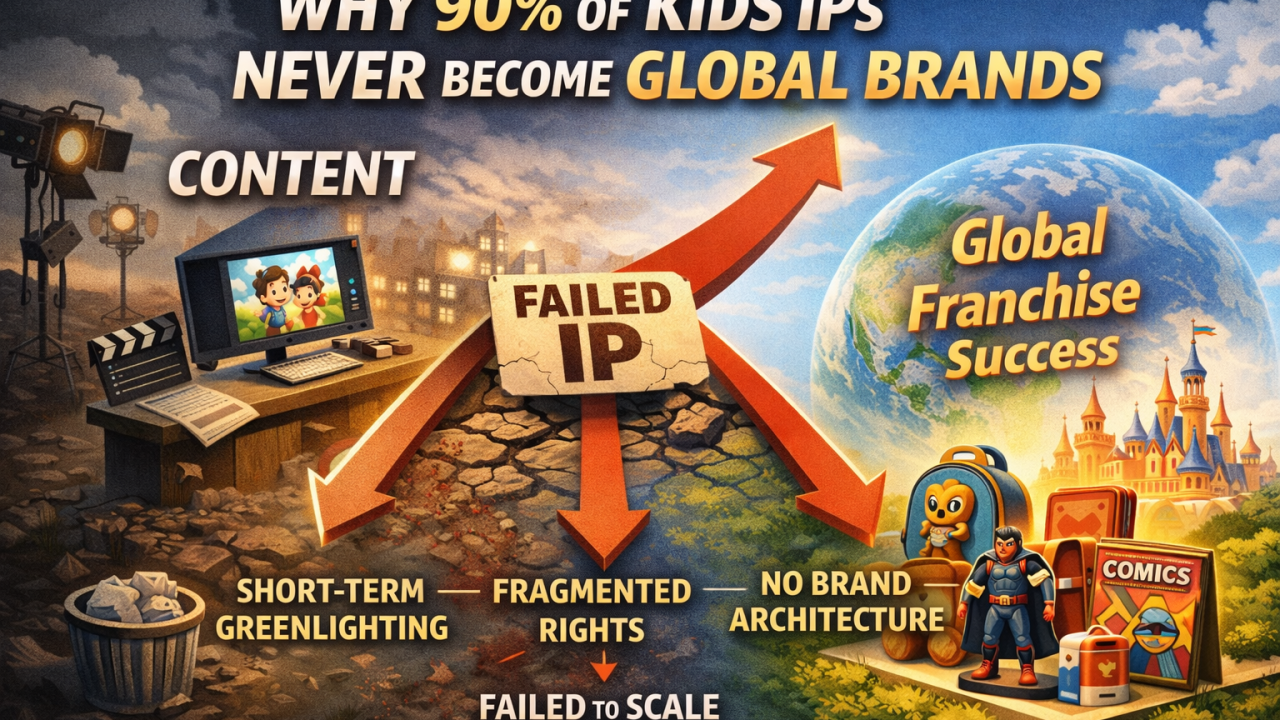
The structural flaw in how the global kids industry designs, commissions, and finances intellectual property
The kids industry tells itself a comforting story.
If the show is good enough. If the characters are lovable enough. If the ratings are strong enough.
The franchise will follow.
This belief is wrong.
Most kids’ IPs do not fail because they lack creativity. They fail because they were never designed to become franchises.
After three decades of building, co-producing, selling, and advising on kids’ IP across markets, one pattern repeats with uncomfortable consistency:
The franchise is usually dead on the term sheet, not on the screen.
We like to blame changing tastes. Platform algorithms. Retail volatility. Market fragmentation.
But the real problem is structural.
We have built an industry that is exceptionally good at producing content, and structurally bad at producing brands.
The First Failure: We Confuse “Greenlight-Ready” with “Franchise-Ready”
Today, most development and greenlight decisions are optimized for:
- Format fit
- Episode economics
- Delivery reliability
- Short-term audience sampling
They almost never test for:
- Character extensibility
- World scalability
- Play-pattern depth
- Multi-vertical translation
So we systematically greenlight shows that are optimized to get commissioned, not to become franchises.
A show can be:
- Well written
- Well directed
- Well performed
And still be:
- Commercially un-extensible
- Un-licensable
- Un-scalable
Franchise DNA is rarely part of the development checklist.
We build shows to survive the commissioning process. Not to survive ten years of brand building.
The Second Failure: The Commissioning Model Works Against Franchises
Greenlight committees are rewarded for:
- Hitting budgets
- Delivering on time
- Filling schedule slots
- Meeting near-term performance metrics
They are not rewarded for:
- Creating ten-year IP assets
- Preserving long-term brand control
- Designing for consumer products
- Building multi-platform life
This creates a structural paradox.
The people who decide what gets greenlit are not responsible for whether it becomes a franchise.
No executive is promoted because an IP became a global brand ten years later. They are promoted because a show launched successfully this year.
So long-term world-building is discouraged. Season continuity becomes fragile. Franchise risk is penalized.
The system produces good shows. It rarely produces enduring brands.
The Third Failure: Most Franchises Are Killed in the First Deal
Across global co-productions and platform agreements, the same pattern appears again and again:
- Fragmented rights
- Territory carve-outs
- Format ownership splits
- Merchandising pre-emptions
- Platform freezes on exploitation
By the time the show succeeds creatively, no one owns enough of it to build a global franchise.
Studios celebrate closing the deal. They rarely audit what they have given up.
Many IPs are:
- Creatively successful
- Commercially trapped
A franchise cannot be built on:
- Five-way ownership
- Frozen territories
- Platform veto rights
- Diluted brand control
The IP is financially dead long before it is culturally alive.
The Fourth Failure: We Confuse Popularity with Brandability
This is one of the industry’s most expensive misunderstandings.
Children may love a character. Retail may still reject it.
Because brandability depends not on love, but on:
- Silhouette strength
- Range architecture
- Play-pattern diversity
- Price ladder viability
- Shelf differentiation
Many hit shows fail at retail because:
- The character does not translate to toys
- The world does not generate product categories
- The IP cannot sustain range depth
Cute is not a business model. And popularity is not a franchise strategy.
The Final Failure: We Optimize for Margin, Not for Enterprise Value
Most production companies are trained to optimize:
- Production margins
- Service revenues
- MG recovery
- Cash flow
They are rarely structured to optimize:
- Long-term IP equity
- Brand asset value
- Multi-cycle monetization
This leads to a fatal trade-off.
The industry repeatedly sells future billion-dollar franchises for short-term production security.
Great companies are not built on delivery margins alone.
They are built on:
- IP ownership
- Brand control
- Long-life assets
Enterprise value comes from franchises. Not from episodes.
The Real Conclusion
The kids’ industry is not short of talent. It lacks architecture.
Franchises are not accidents. They are engineered.
They are designed in:
- Development
- Commissioning
- Rights strategy
- Franchise architecture
- Long-term brand thinking
Long before the first episode is delivered.
Until we redesign how we develop, commission, and finance kids IP, We will continue to celebrate successful shows and quietly bury failed brands.
The problem is not creativity.
The problem is the system.