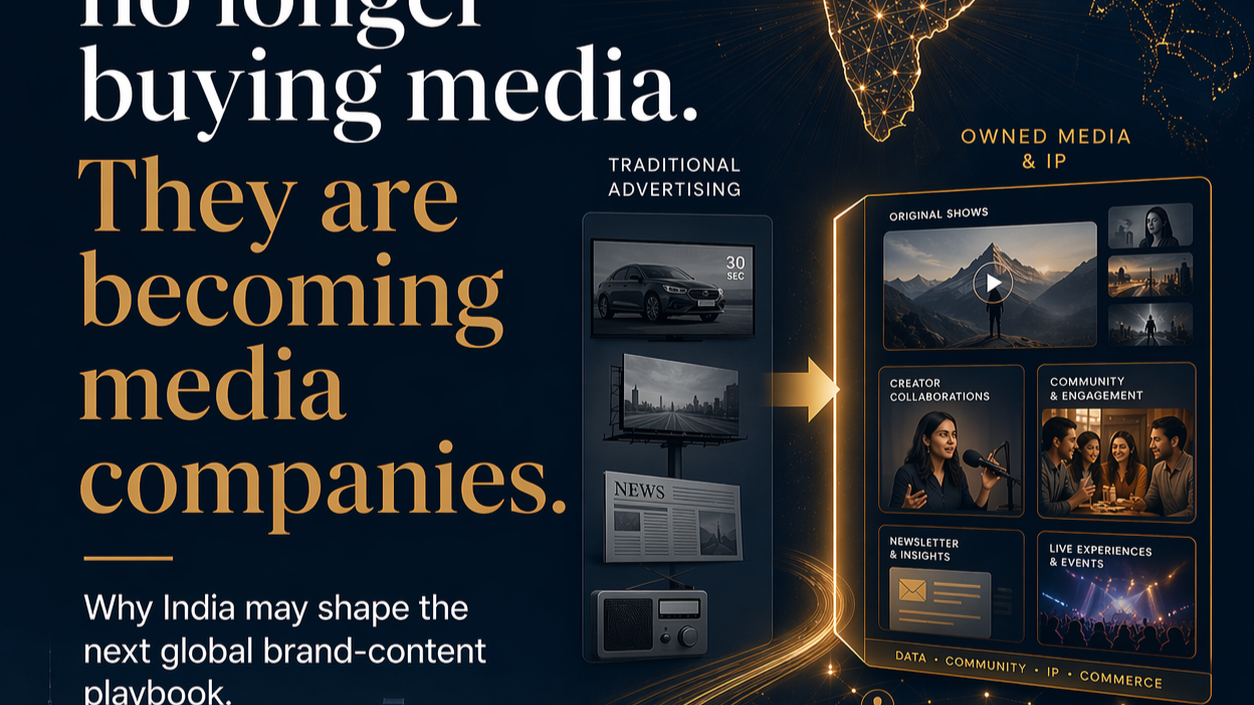
And nowhere is this shift more exciting — or more urgent — than in India.
India is now one of the world’s most powerful entertainment and consumer markets by audience scale. What happens here in the next five years could significantly influence the global brand-content playbook.
For decades, brands bought attention.
A television spot.
A celebrity endorsement.
A festive campaign.
A media plan.
A burst of visibility.
But the rules of attention have changed.
Today, audiences do not merely consume advertising. They follow stories, creators, characters, communities, games, sports moments, music, anime, podcasts, festivals, and cultural experiences.
In other words, brands are no longer competing only with other brands.
They are competing with entertainment.
And the smartest brands are responding not by spending more, but by building better.
India’s creator economy already influences over US$350 billion in annual consumer spending — with the potential to cross US$1 trillion by 2030. Nine in ten CMOs globally are increasing investments in entertainment IP partnerships. With one of the world’s largest internet audiences, India already has the scale.
The question now is whether brands have a strategy.
Because here is the real issue:
Is your brand still renting attention, while your competitor is building an asset?
A campaign ends.
A media buy expires.
A post disappears in the feed.
But a strong IP can travel.
It can become a series.
A character.
A community.
A game.
A live experience.
A licensing opportunity.
A creator collaboration.
A cultural movement.
This is the difference between content as expense and content as enterprise value.
India now has its own extraordinary opportunity.
We have the audience scale.
We have mobile-first distribution.
We have creators with influence.
We have a young population hungry for stories.
We have regional cultures with extraordinary narrative depth.
We have brands seeking deeper engagement beyond discounting, media noise, and short-term visibility.
Globally, we have seen this play out through brands like Red Bull, Nike, LEGO, LVMH, Mattel, and many others — brands that understood early that storytelling is not merely a marketing function. It is a long-term business strategy.
Not every brand needs to produce a film.
Not every brand needs to launch a web series.
Not every brand needs to become a studio.
But every ambitious brand should ask:
What story do we own?
What community do we serve?
What cultural space can we credibly occupy?
What content asset can outlive our quarterly campaign?
After 26 years in the media and entertainment business, I have seen one truth repeatedly:
Brands that chase attention have to keep buying it.
Brands that own stories can keep compounding it.
For Indian brands — and for global brands operating in India — the next frontier of marketing will not be only about reach, impressions, or views.
It will be about creating content and IP assets that build trust, community, cultural relevance, and long-term brand value.
The future will belong to brands that stop asking:
“How much media should we buy?”
And start asking:
“What media asset can we build?”
At Kynzo Media Group, this is one of the spaces we are deeply interested in — helping brands think through content, IP, storytelling, creator ecosystems, entertainment partnerships, and long-term audience ownership.
I will be writing more about this in the coming weeks.
Would love to hear from brand leaders, CMOs, founders, and agencies:
Is your brand still buying attention — or are you ready to start building IP?
A banking consulting agency is a third-party firm that advises businesses on banking and financial matters. They can help with business strategy, operations, and long-term outcomes. Crowe is a recognized leader in banking consulting. and the overall business value of their AI investments.